When You Can’t Unsee the Pattern
For me, self-discovery didn’t begin with a checklist.
It began with a single sensory clue: I’m dependent on visual contrast.
That was the spark. I was fascinated by this trait that remained unseen for decades, and I felt the urgent need to understand it. I linked it to Sensory Processing Disorder, and suddenly, the rest of the autism map came into focus. Traits I’d lived with for years slotted neatly into place. The ones that didn’t? They weren’t wrong — I was missing details. When I found those details, the map felt complete.
It was not about seeing myself in someone else’s story. Media resonance came later, more like the same map under different weather.
What I Mean by Patterns
A pattern is something that repeats (a behaviour, a reaction, a sensory quirk) across different moments and places in your life. (See also the Wikipedia pages about patterns and the pattern recognition.)
Some patterns are obvious. Others hide under layers of “normal” until you know what to look for.
For me, some patterns were what I used to call intuition.
They were the subtle links my brain made without conscious effort; only I didn’t realise they were links.
Challenging the Patterns
When I started suspecting autism, I didn’t just accept or reject it. I tested it, looking for contradictions.
When I found them, each time, there was an explanation:
- A “missing” trait turned out to be hidden by masking.
- A behaviour I thought was unrelated was actually a co-occurring trait (like ADHD, dyspraxia, dyslexia, alexithymia or fawning).
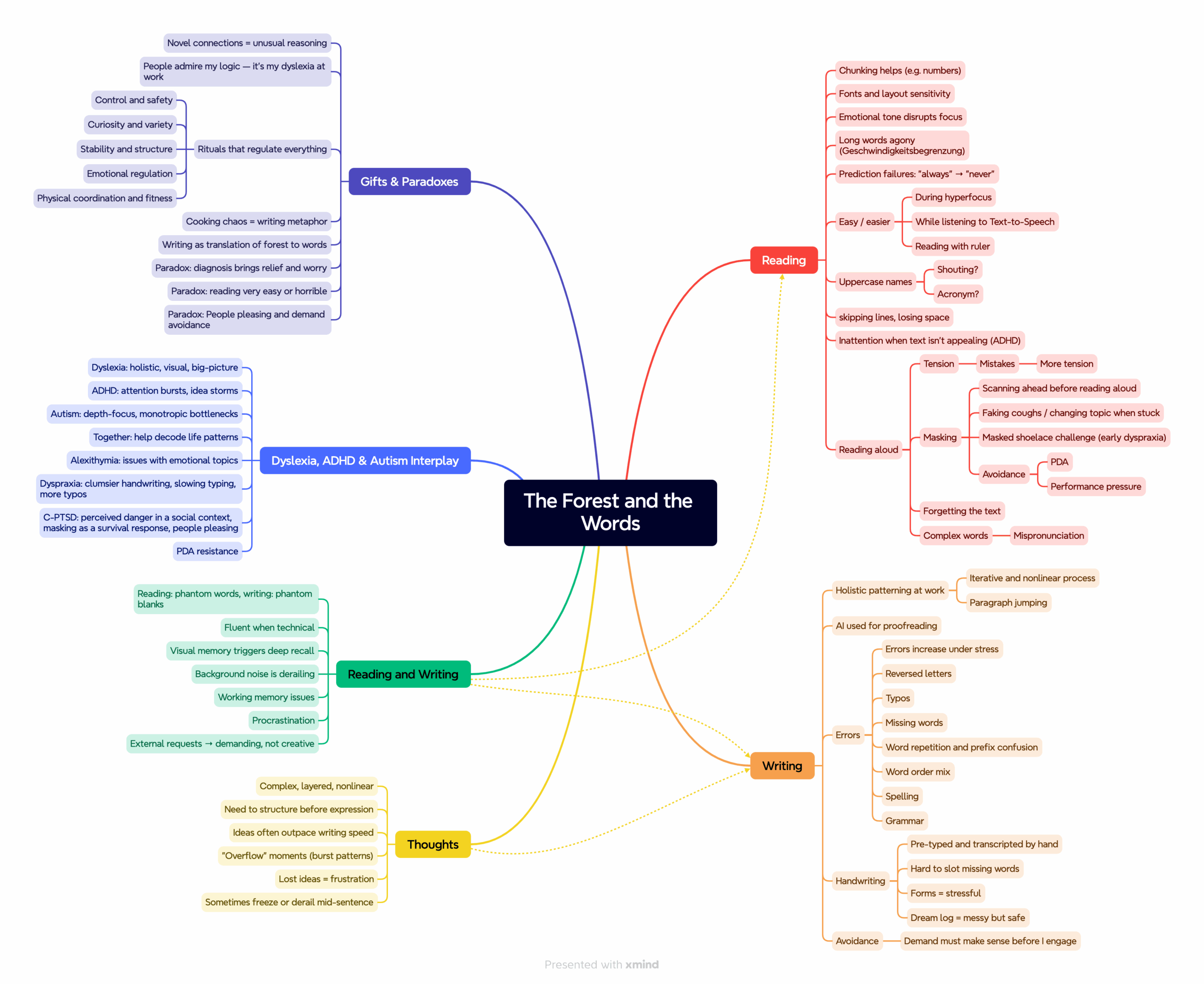
If you’ve spotted patterns, challenged them, and they still stand? They’re probably real.
Why Denying Patterns Feels Like Lying to Yourself
For me, ignoring a solid pattern would be like deleting the right section of a map and pretending it was never there.
The brain seeks coherence: once you’ve seen the same shape appear in your life over and over, denying it creates friction.
And if you’re autistic, that friction can be unbearable.
For the Self-Diagnosed Autistic Reader
If the patterns are there, and they’ve survived your own stress-testing, your self-recognition is valid.
A professional diagnosis can be useful for accommodations, but the absence of one doesn’t erase the reality you’ve mapped.
If Someone You Know is Autistic
If you’re reading this to understand someone close to you:
- Patterns aren’t “imagined” — they’re data.
- Autistic self-discovery often feels less like guessing, more like reverse-engineering a system you’ve lived in all your life.
Once the pattern emerges, it’s almost impossible to unsee it.
Closing thought
For me, recognising autism was the moment the picture on the puzzle box matched the pieces on my table. The patterns were always there. All I had to do was look closely enough.
I’d love to hear about your experiences; do they match mine or take a completely different path? If this resonates with you (or even if it doesn’t), you’re welcome to share your thoughts in the comments or contact me directly.
Leave a Reply to Pattern Anomaly Detection – Mixed Effects Cancel reply