
The Pattern in Chaos
I used to dismiss the idea that I could be on the autism spectrum, and one reason was that my life looked too chaotic. But I now see my world like a thunderstorm: chaotic on the surface, but following meteorological patterns.
Routine vs Ritual — What Shapes My Life
I don’t have many simple, strict routines. What I do have are rich rituals: complex patterns that meet my need for predictability, exploration, safety, coordination, calm and fitness (often simultaneously).
For example, my breakfast often includes soft yoghurt + crunchy cereal as I thrive on contrast. The yoghurt with cereal is one of the few simple routines I follow, but the breakfast as a whole forms part of a larger ritual.
I can choose to have bread instead if I decide or get it offered (flexibility exists in the ritual). But when the yoghurt routine becomes part of the ritual on a given day, and I unexpectedly can’t follow it (e.g. I’ve run out), that disruption can unsettle me, especially if I’m already stressed or tired. The issue isn’t sameness for its own sake; it’s the unexpected break in the familiar pattern that can create distress.
How My Rituals Serve Me
Without realising it, I designed my rituals to meet several of my neurodivergent needs together:
- ASD: Stability and structure.
- ADHD: Curiosity and variety.
- C-PTSD: Control and safety.
- Alexithymia: Emotional regulation without having to name the feelings.
- Dyspraxia: Coordination exercises and challenges, involving fitness activities.
- SPD: Sensory regulation.
- Executive Function: External scaffolding that offloads memory and reduces decisions.
- And possibly some other traits.
My subconscious built these systems long before I consciously understood why. It gives me predictability and freedom at the same time.
The Pattern Behind My Patterns
When I reflect on my rituals, I see that they don’t just follow steps but follow patterns as a whole. This is something I now understand as part of how my dyslexia shapes my thinking.
Instead of building life from simple, linear routines, I’ve created rituals that work like maps: they link different needs, ideas, and goals into one bigger picture. This kind of holistic patterning helps me hold my world together, connecting stability, variety, and safety all at once.
The oldest ritual I still use dates back to 2013. It’s changed over time, but its core — that sense of a living, connected system — hasn’t.
What looked like random chaos was really my way of building a pattern I could trust.
Rituals, Not Compulsions
Breaking those rituals feels like I’ve compromised my values, acting against the beliefs and practices that define who I am (on some days it can even feel like I’ve unleashed chaos, as if I’ve invoked the devil and disrupted the natural order of things; and I’m actually quite amused when feeling that way — unless the pattern becomes systemic).
Some of my rituals — like cycling micro-adventures or exercise goals — might look like OCD traits because they involve rules (e.g. distance, elevation, places). But they bring joy, regulation, and health, not anxiety relief. I don’t feel intrusive distress if I miss the target; I feel disappointment, but it passes.
These rituals reflect my way of balancing sensory, emotional, and executive needs. My cycling is also part of a special interest that connects structure with discovery.
When Routine Becomes Rigid
In some areas (especially where safety is involved) I do follow strict routines (e.g. checking the dishwasher, locking doors). In other areas (like laundry), my structure varies depending on the context or stress level.
Illustration: One Task, Two Brains, Both Mine
Below is a classic autistic-style routine: clothes sorted, folded and ordered — my need for structure satisfied.
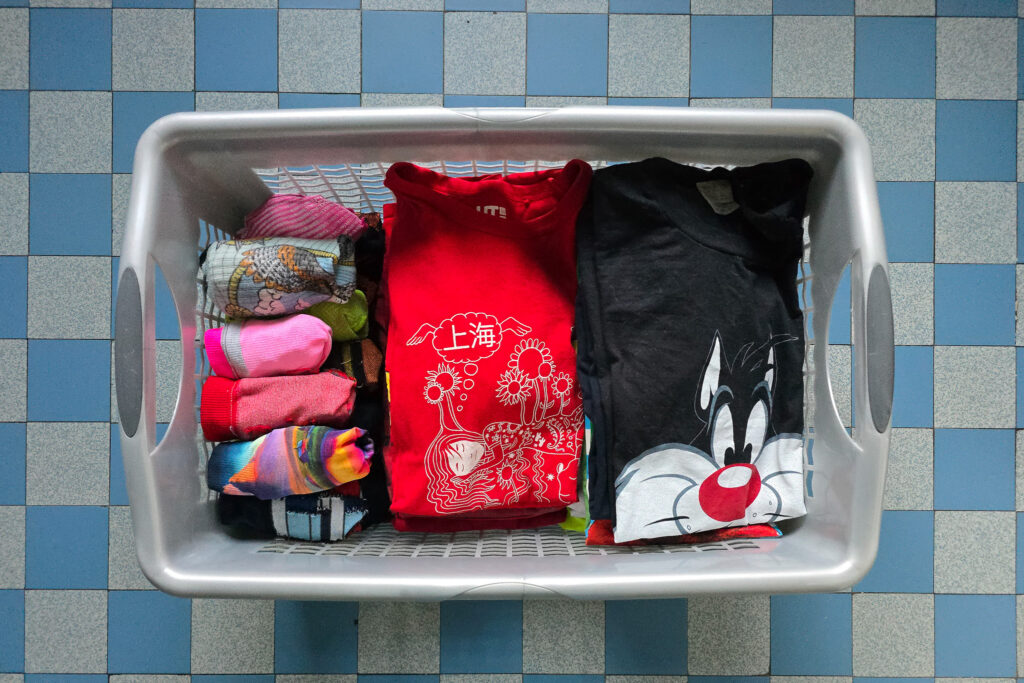
Then, my ADHD chaos: clothes dumped in exhaustion, moved later, falling, collecting cat hair. This happens when something more important is in my mind, my executive function crashes or when I’m overwhelmed.

These photos show how my routines can either hold me steady or fall apart, depending on my state. They reflect the push-pull between the need for structure (ASD) and the struggle to maintain it (ADHD). While those photos are only an illustration of a specific case, my rituals often allow me to live with my two different types of brain.
Conclusion
Looking back, I see my rituals as my brain’s way of keeping me safe, steady, and engaged, even when I didn’t know I needed that. What seemed like chaos was really a carefully designed system for living well with my traits, and to create them, I used techniques that I didn’t even know existed.
Leave a Reply