I’ve never understood society’s love affair with cars. Paying a fortune to sit in a metal box? Traffic jams that feel like prison sentences? Upgrading cars just to “keep up” with neighbours? To me, it’s like buying a ticket to Pandemonium.
I hate the roar of engines, the smell of exhaust, and the rumble of diesel cars. Even electric cars buzz and whine in ways that sometimes grate on my nerves. Not mentioning that honking cars trigger in me a fight-flight-freeze reaction. (Though I’ll admit: vintage cars have a certain honest charm, like a classic vinyl record.)
I love walking and cycling—they keep me grounded, connected to the world in a way that feels authentic and free. For years, I resisted getting a license– my main worry was to become physically inactive. But after dozens of people insisted, “You might need it someday!” I signed up for driving school. What happened next?
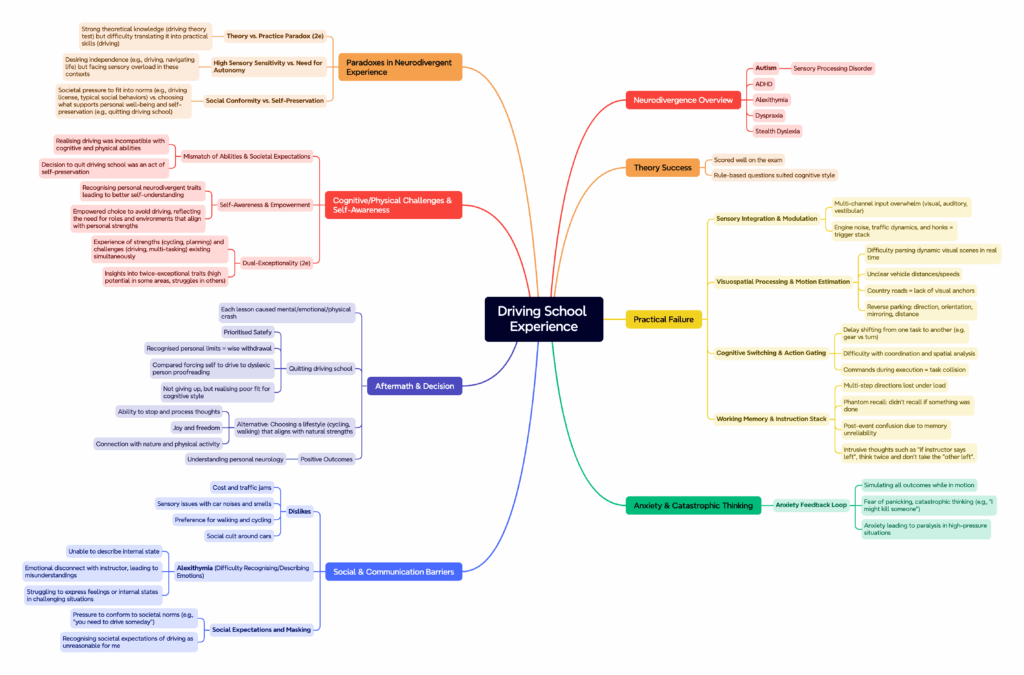
Ironically, the theory part went extremely well. I expected tricky or ambiguous questions, but most were clearly structured and rule-based — which suited me perfectly. I think I scored 85 out of 87 on the exam. That success gave me hope that maybe driving would “click” with practice. But it quickly became clear that what worked on paper didn’t translate behind the wheel.
It turned into a living hell. Now that I understand neurodivergence, I can describe the experience with words that make more sense than “driving is not something for me”.
Driving school was a sensory and cognitive nightmare. Coordinating steering, pedals, mirrors, and spatial analysis proved extremely difficult. After several weeks, I saw no progress—only frustration. The constant sensory processing overwhelmed me: engine noise, traffic visuals, and simultaneous stimuli from pedestrians, signs, and mirrors created a sensory tsunami that left me feeling like I was drowning in information.
On country roads, I’d freeze at intersections. Without buildings or other visual anchors, approaching cars seemed to speed up/slow down randomly. My brain struggled to interpret the empty space—was that car 5 seconds away or 20?
I couldn’t quickly sweep the whole landscape and judge all the moving parts; the visual scene felt too wide, too fast, and too fluid for me to process in real time. I’d stand paralysed, desperately trying to calculate safe gaps while my instructor grew impatient. The open road offered no reference points, leaving me to guess at physics my brain couldn’t compute.
I developed an anxiety feedback loop. It was like panicking about the risk of panicking: “What if I meltdown on the highway?“ This fear paralysed me, making it difficult to focus. I fixated on catastrophic outcomes like “I might kill someone”—thoughts incompatible with the split-second decisions required for safe driving.
The unspoken social rules of eye contact, lane changes, and right-of-way felt like a chaotic dance. Juggling navigation, speed control, and hazard scanning overwhelmed my working memory. It was like trying to solve a Rubik’s Cube while riding a unicycle—impossible and exhausting.
And then there was parking—the ultimate test of precision and spatial awareness, which for me felt like an insurmountable challenge. Manoeuvring the car into a tight space and judging distances felt like to solving a complex puzzle with pieces that just wouldn’t fit, adding another layer of stress to the already overwhelming experience of driving.
The challenges extended beyond just the mechanics of driving. There was a fundamental communication barrier between my instructor and me. I was totally unable to articulate how I was feeling or what I was experiencing. It wasn’t just about finding the right words—it was about first identifying and then translating my internal state into something comprehensible to both of us. This difficulty in recognising and describing emotions, sometimes called alexithymia, made an already challenging situation feel even more impossible to navigate. The frustration from this disconnect made the overload of feelings and thoughts even worse, leading to a situation full of misunderstandings and stress.
Each lesson left me completely drained—mentally, emotionally, physically. I would come home and collapse, like I’d just spent hours defusing bombs instead of learning a basic life skill. It was the most exhausting experience I’d ever had, and the effort never seemed to bring progress.
I quit before the driving exam, and it was my wisest decision. I prioritised safety by recognising my limits before endangering myself or others. Though I didn’t understand my neurology at the time, I honoured it. I now understand that forcing myself to drive would have been like a dyslexic person insisting on becoming a proofreader—a perfect recipe for burnout.
The pressure to drive wasn’t just about personal limitations—it reflected societal expectations that disregard individual needs. Some told me not to give up, insisting I might need that license someday. But I chose not to force myself into a role that didn’t suit my abilities or needs, despite their insistence– which did feel as unreasonable as telling a wheelchair user to “just try walking.”
Even as a passenger, I often feel terrified — as though my senses are being hijacked without my consent. It’s especially true when the driver or vehicles (the one I’m in and the others around) are unpredictable. I usually try to mask my stress, but once I was the passenger of a reckless driver; and probably flirted with a panic attack, so I just left the car and I called a taxi to rescue me.
My joyful alternative is a bicycle, two feet, and more distance ridden annually than most motorists. The trails are my open road, climbs my challenge, and nature my playground. Every pedal stroke reminds me of my freedom and celebrates my unique way of navigating life. When I’m confused or overwhelmed, I can easily stop to process my thoughts—something I could never do safely while driving. The peaceful rhythm of riding my bike through nature doesn’t just clear my mind; it also makes me feel happier and more energised in a way I can really notice, as if each turn of the wheels helps bring my emotions back into balance. This natural activity seems to support my body and mind in just in the right way, and I am very grateful that I started cycling at a very young age, otherwise it might have ended up as something “not for me“.